What Is Co-Reading? Why We Built a Story You Read Together

VividMindsPress Team
10/12/2026
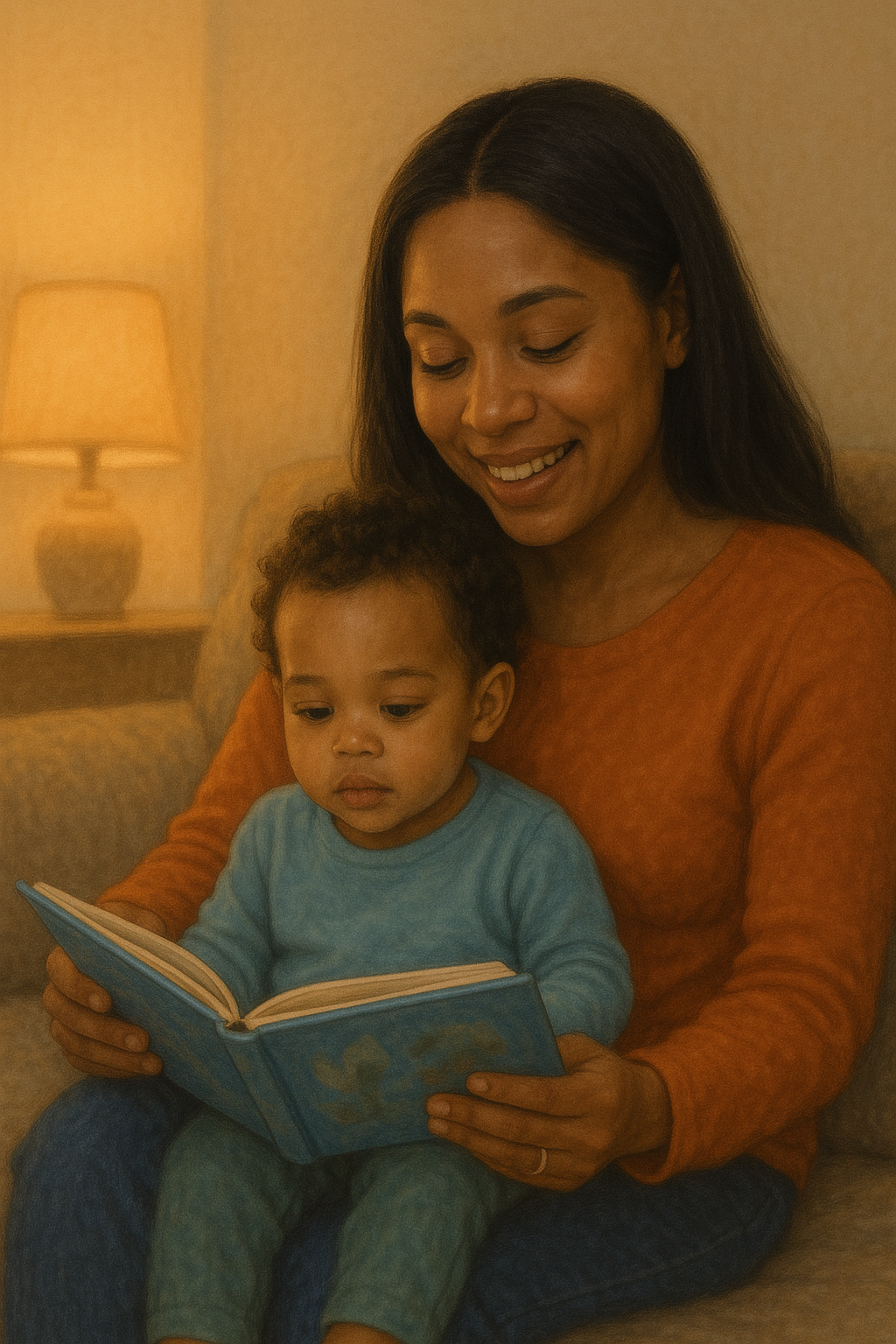
What Is Co-Reading? Why We Built a Story You Read Together
Co-reading means reading together—you and your child, side by side, looking at the same pages, talking about the story as it unfolds.
It's different from independent reading (where your child reads alone) and different from passive screen time (where a narrator reads while your child watches alone).
Co-reading is interactive, relational, and deeply beneficial for children ages 3 to 6.
Why "Together" Matters
When you read with your child rather than to your child or for your child, something powerful happens:
Back-and-Forth Exchanges
You pause to ask questions. Your child points to a picture and asks what it is. You expand on what they notice. They predict what happens next. This conversational turn-taking builds language skills more effectively than passive listening.
Research by Romeo and colleagues (2018) found that conversational turns—these back-and-forth exchanges—were more predictive of language development than the total number of words children heard.
Shared Attention
You're both looking at the same pages, following the same story. This "joint attention" helps children learn to focus, follow narratives, and connect words to images.
Emotional Connection
Physical closeness while reading—sitting together, pointing at pages, sharing reactions—builds the parent-child bond. Reading isn't just an educational activity; it's relationship time.
What Co-Reading Looks Like
For ages 3 to 6, co-reading includes:
- Asking questions: "What do you think will happen?" "How does she feel?"
- Following their lead: If they're curious about one page, staying there longer
- Expanding their language: When they say "dog," you say, "Yes, a big brown dog with floppy ears"
- Making connections: "Remember when you felt nervous like that?"
- Letting them participate: Turning pages, pointing to pictures, finishing familiar phrases
The American Academy of Pediatrics' 2024 policy statement on literacy promotion emphasizes this interactive approach. They recommend shared reading that's responsive to the child's interests and includes open-ended questions, expansions of what the child says, and genuine conversation.
Why We Built Stories for Co-Reading
At VividMindsPress, we create daily stories about three puppies—Chloe, Brady and Julie—designed specifically for co-reading with ages 3 to 6.
The Screen Is Just the Delivery Method
Our stories appear on a screen, but they're not designed for passive viewing. There's no animation, no autoplay, no narrator taking over. The words and pictures are there for you and your child to explore together.
You hold the device (or prop it up), you read aloud, your child looks at the pages with you, and you talk about what's happening. The screen delivers the story, but you bring it to life.
Natural Stopping Points
Each page has a gentle rhythm that invites pauses—moments where you can ask, "What do you see?" or "What do you think Chloe will do?"
The language is written for reading aloud, not for silent reading. The sentences have rhythm. The dialogue invites different voices. The pacing gives you room to interact.
Familiar Characters, Fresh Adventures
One of the benefits of co-reading is repetition. Children love hearing the same story over and over, noticing new details each time.
With Chloe, Brady and Julie, your child gets the comfort of familiar characters (the same three puppies every night) plus the novelty of new adventures. This supports co-reading because your child already knows who these puppies are, so they can focus on what happens today.
Co-Reading on a Screen: Honest Guidance
Let's be direct: research on e-books and screen-based reading is mixed, and we want you to understand what we know.
What Research Shows
A 2019 study by Munzer and colleagues found that parents and toddlers talked less when reading on tablets compared to print books. The screen seemed to reduce interaction.
However, other research (Reich et al., 2019) found comparable engagement and story comprehension with e-books when parents stayed actively involved.
The difference? Whether the adult stayed engaged or whether the screen took over.
How to Co-Read on a Screen Well
If you're going to read a story on a screen with your 3 to 6 year old, here's what helps:
✓ You hold or prop the device. Don't hand it to your child to use alone.
✓ You read aloud. Don't let autoplay or a narrator replace your voice.
✓ Talk about the pages. Point to details, ask questions, let your child respond.
✓ Dim the screen. Especially before bed, reduce the brightness to minimize blue light.
✓ Finish before lights out. End story time a few minutes before sleep to allow your child's eyes and brain to settle.
The AAP's family media guidance suggests screen-free zones for young children, particularly before bed. We designed our stories for the wind-down period before that screen-free zone—a short, gentle session you read together, then transition to brushing teeth and lights out.
Would a Print Option Help?
We're exploring a print-at-home option for families who prefer reading on paper. Let us know if that would be useful for you.
Try Co-Reading Tonight
Our stories about Chloe, Brady and Julie take about 5 to 10 minutes to read together. Every adventure begins with curiosity and ends at home—giving your child a complete, satisfying story in one session.
Your first story is free with a free account.
Frequently Asked Questions
Is co-reading better than independent reading?
They serve different purposes. Co-reading (ages 3 to 6) builds language, connection, and pre-literacy skills. Independent reading (usually starting ages 5 to 7) builds decoding skills and confidence. Keep co-reading even after your child can read alone. You can share more complex books together than they can read independently.
Can audiobooks replace co-reading?
Audiobooks provide language exposure, which is valuable, but they miss the interactive, relational component. Use audiobooks during car rides or quiet time as a supplement, not as a replacement for co-reading when you can be together.
What if my child wants to "read" the story themselves?
Let them! If your 4 or 5 year old wants to hold the book and tell the story from the pictures, that's wonderful emergent literacy behavior. You can take turns—they "read" one page, you read the next—or let them lead and chime in when they ask for help.
My child just wants to look at pictures, not listen to words. Is that okay?
Yes, especially for younger 3 year olds. Looking at pictures, talking about what they see, and making up stories are all part of pre-literacy development. Gradually, they'll become more interested in the words as their attention span grows.
How is VividMindsPress different from other story apps?
Most story apps are designed for kids to use alone, with narration, animation, and interactive games. We designed our stories for you to read together—like a picture book on a screen. No autoplay, no narrator. Just you, your child, and the story.
Does co-reading work for younger or older kids?
Absolutely. Co-reading benefits children from birth through elementary school and beyond. We focus on ages 3 to 6 because that's when children are ready for short story narratives but not yet reading independently. Adapt co-reading techniques for other ages: simpler books and more labeling for babies and toddlers, more complex discussions for school-age kids.
References
American Academy of Pediatrics Council on Early Childhood. (2024). Literacy promotion: An essential component of primary care pediatric practice. Pediatrics, 154(6), e2024069090.
Romeo, R. R., Leonard, J. A., Robinson, S. T., West, M. R., Mackey, A. P., Rowe, M. L., & Gabrieli, J. D. (2018). Beyond the 30-million-word gap: Children's conversational exposure is associated with language-related brain function. Psychological Science, 29(5), 700-710.
Munzer, T. G., Miller, A. L., Weeks, H. M., Kaciroti, N., & Radesky, J. (2019). Parent-toddler book reading in the digital age: Differences in book selection, shared reading, and parent-child interactions. Pediatrics, 144(4), e20182012.
Reich, S. M., Yau, J. C., & Warschauer, M. (2019). Tablet-based eBooks for young children: What does the research say? AERA Open, 5(1).
American Academy of Pediatrics. Family media plan. Available at HealthyChildren.org.
National Association for the Education of Young Children (NAEYC). (2021). Reading aloud with infants and toddlers. Available at naeyc.org.
Start your storytime ritual
Read illustrated stories together and track your child's reading journey — free to start.
Start reading together